How children should behave in church, and what limits should be set can be quite a contentious issue. Personally, I like children in church. I don’t even think it is tantamount to a crime to hear them babbling or fussing in church. Over the years as a pastor’s wife and a La Leche League Leader, I’ve heard so many stories about getting the evil eye by simply walking into the sanctuary with a babe in arms or a toddler. Obviously, if your child is proving to be a distraction or too loud for others to hear, it is a matter of consideration to take them out and deal with it. What that means is defined by your family perspective on it and the age and temperment of your child.
But I am a firm believer in “faith comes by hearing,” and children certainly belong in the presence of their savior, and need to be a part of the body of all believers from the instant they are baptized. I am always scared that nurseries, children’s church, or Sunday school during church give one of two (or both) messages to children: That they don’t belong in the presence of God, or that they should be involved in activities that are more fun than church. Either message can be incredibly damaging to their faith. We segregate so many aspects of life according to age, I don’t believe worshiping our Lord and receiving His gifts is an area where we should be doing t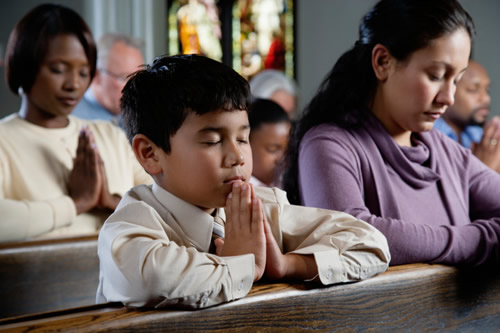
That being said, having children in church can be a challenge. I ought to know. As a pastor’s wife, I am a single parent on Sunday. With so many men who are not involved in church anymore, and so many babies not born into nuclear, married families—many women are put in the position that if they want to go to church, they have to take care of their kids alone, and so many of them put off the challenge of having children in church until an age when they might be easier to handle.
I don’t think there is an age that is “easier to handle.” Babies and toddlers are truly a challenge, but they don’t get easier, they just change how they fight against it, if they are not used to it.
I don’t want to make it seem like I believe this is easy. There were days I stayed home because I wasn’t up to the fight of keeping Maggie in the pew that day or dealing with Chris’s moods (he definitely was NOT a morning person. A wonderfully friendly person would go up to him and say “Good morning, Christopher, and he would glare at them and yell “NOOOO” and then bury his head in my shoulder). And there were days when I wonder why I was there because I didn’t hear a word of the sermon, wasn’t able to go to communion, etc. and I was exhausted or in tears the rest of the day (which is why having a husband or family there with you is wonderful.) But as I sit with my kids in church now, and even watch them frequently go to church even when I can’t, simply because they want to, I know that it was worth it.
So here are some things that did make it easier for me:
1. Sit in front. Most parents have a tendency to sit in the back because they don’t feel like the whole church sees when their children act up, and they can make an easy exit. But scooch down to your child’s level. They can’t see anything besides the back of people’s heads. They don’t see why they are there. They often behave a lot better when they can see what is going on.
In our church, there are side aisles, so while I sat up front, I didn’t necessarily sit front and center, so I could still make an easy exit. There even was a door off to the side to a hallway. But even if you don’t have that, it is less distracting to everyone than you think if you need to walk down the aisle (side) or the nave.
2. Bring quiet toys, non-messy snacks, and a drink in a bottle or sippy cup (or discreetly nurse). The fact of the matter is, young children don’t have the attention span to deal with nothing but church for the whole service, and having something quiet to do helps, and if nothing else, it helps you. Chris used to love to stack hymnals, and when he got done, he would put them in a new stack. Plastic animals, stuffed animals, Hot Wheels (if your kid is not the kind that goes Vrroomm) or coloring books can be a help. And also, kids behave better when their blood sugar is even. Something like Cheerios is generally fine. And, having a drink right there means there is one less reason to take them out which means you get to hear more.
3. Pay attention to what is developmentally appropriate. For instance, a baby or toddler will have difficulty sitting still. He is not being rebellious or difficult, his mind is just hard-wired for movement at that age. Also, take into account temperament. My son Chris could sit still and become absorbed in books at an early age. At the same age, Maggie needed to move.
I would take my kids out if they couldn’t sit still, but somewhere around late two or early three, it became clear to me that it wasn’t that my child COULDN’T keep from being active, he just didn’t want to. This was then more of an issue of limits rather than ability. When this became the case, leaving the sanctuary meant that we went and sat perfectly still in a chair for 5 minutes out in the parish hall. They then learned that since snacks, coloring books, etc. were still in the church, they could actually do more in church than they could if we left.
Children are even hard-wired to challenge limits. My rule was they could play quietly in the pew, but couldn’t leave the pew. Maggie would go to the edge of the pew, get “that look” in her eye and then bolt. We’d do the chair in the parish hall thing and then I’d ask, “are you ready to go sit in the pew now?” Often, especially at first, we’d be right back in the parish hall in five minutes. After a while, it became a non-issue. As frustrating as this is, it is actually quite normal, and is part of their learning to think for themselves. Your job is to set good limits and make them stick!
I know a discussion on my homeschool board had where some parents with each five minutes their child was good they’d give them a pile of tokens and then take one away for each infraction during church. With my kids, just leaning over and whispering to them, “you are being SO good” was enough. If I were doing tokens and such, I’d be inclined to give them one every five minutes that they were good rather than take them away. Some kids will do anything to keep from losing one, and with my kids — Maggie probably would’ve cried, and Chris would’ve debated with me why he shouldn’t have lost it.
3. Try 1-2-3 Magic. This is a book or video you can generally get in the library or at Barnes and Noble/Borders. When I was working as a social worker, this was one of the programs we taught to parents who were in the DCS system. IT takes the emotion out of it, which is nice, and sets clear warnings. I was going out of my mind with my daughter who bounces off the walls, and when I started using it, it helped SO much. It worked great in the home, but it worked MARVELOUSLY in church. Maggie was three, and very active. She’d forget to whisper if she had to tell me something, I could just hold up one finger. Three minutes later, she might start trying to walk out of the pew. I’d gently grab her wrist (my reflexes were getting pretty good by this point) and bring her back and hold up two fingers. If something else happened that was not right, within that fifteen minute time period, she got a time out. At first, I went out with her, but eventually, I could just have her stand right in the hallway, in view through the doorway, and then just wave her back when I wanted to. I wasn’t missing church anymore because of her!!
It also wasn’t long before we rarely ever got to three.
So, what worked or works for you? I’d be eager to hear, and I’m sure it would help other parents as well.


